On this page11 sections
- What does KSM-66 mean on an ashwagandha label?
- KSM-66 vs ordinary ashwagandha powder
- How to read extract, ratio and “equivalent” figures
- Per tablet or per serving? The easiest number to misread
- Withanolides: what the 5% means
- What to check before you buy KSM-66 ashwagandha in the UK
- What UK rules say about ashwagandha
- Taking KSM-66 tablets: follow the label
- Where Nature Elixirs KSM-66 tablets fit
- Frequently asked questions
- Sources and how this guide was researched
KSM-66 Ashwagandha in the UK: Extract, Dosage and What to Check Before Buying
KSM-66 appears on a lot of UK ashwagandha labels, usually next to a big number. This guide explains what the name actually tells you, how to read the extract, ratio and “equivalent” figures, and which details are worth checking before you buy a bottle of tablets or capsules.
This guide is published by Nature Elixirs. We sell KSM-66 ashwagandha tablets, and we use our own label as the worked example because we can show you every figure on it. The checks work for any brand’s product.
- What KSM-66 isA branded ashwagandha root extract made by Ixoreal Biomed and standardised to at least 5% withanolides.
- The number to compareMilligrams of KSM-66 extract per daily serving, not the “equivalent powder” figure.
- Check the serving sizeWhether the amount is per tablet or per serving of two or more tablets.
- Check the detailsRoot extract, withanolide percentage, full ingredients, directions, cautions and a UK contact.
- Be wary ofProducts promising stress relief, better sleep or more testosterone. No ashwagandha health claim is authorised in the UK.
What does KSM-66 mean on an ashwagandha label?
KSM-66 is not a type of plant or a strength. It is the trade name of one specific ashwagandha extract, made by the Indian company Ixoreal Biomed. Supplement brands buy the extract and put it into their own tablets, capsules or powders, which is why the same name turns up on products from many different companies. KSM-66® is a registered trade mark, so seeing it on a label tells you exactly which extract the brand has used.
Three things set it apart from a generic ashwagandha powder:
- It is made from the root only. KSM-66 is extracted from the root of Withania somnifera, with no leaves added.
- It is standardised. The extract is standardised to more than 5% total withanolides, measured by HPLC (high-performance liquid chromatography, a laboratory method for separating and measuring individual compounds).
- It is made without alcohol or chemical solvents. Ixoreal describes its extraction as a “green chemistry” process.
What the name does not tell you is how much of the extract is in the product you are holding. That depends entirely on each brand’s formula, which is why the rest of this guide is about reading the numbers.
KSM-66 vs ordinary ashwagandha powder
Ashwagandha supplements usually contain one of two things: dried, ground root, or an extract made from the root. KSM-66 is the second kind. Here is how they compare on a label.
| What to compare | Ashwagandha root powder | KSM-66 root extract |
|---|---|---|
| What it is | Dried root, ground into powder | Concentrated extract of the root |
| Plant part | Usually root, but not every label says | Root only |
| Withanolide content | Often not stated | Standardised to at least 5% |
| Typical label line | “Ashwagandha root powder 500mg” | “KSM-66® ashwagandha root extract 300mg” |
| Source | Many different suppliers | One producer, Ixoreal Biomed, under a registered trade mark |
Neither line on its own tells you which product suits you. What a standardised extract does give you is a stated level of withanolides from one identifiable source, so you know what each serving is built around.
How to read extract, ratio and “equivalent” figures
This is where most of the confusion starts. An ashwagandha extract label can carry three different numbers, and each one measures something different.
- The extract amount. The weight of KSM-66 extract in a serving. This is the actual amount of the ingredient you take.
- The ratio. A 10:1 extract means roughly 10 parts of dried root went into making 1 part of extract.
- The equivalent figure. The extract amount multiplied by the ratio. 300mg of a 10:1 extract is “equivalent to” about 3,000mg of root powder.
Equivalent figures are useful context, but they are not a second dose and they are not a measure of strength. Some products put the equivalent figure in the product name, so a bottle marketed as “3,000mg” and a bottle marketed as “300mg” can contain exactly the same amount of extract. When you compare products, compare extract with extract.
Here is how those numbers look on the Nature Elixirs label, per two-tablet serving:
Per tablet or per serving? The easiest number to misread
UK supplement labels give amounts per serving, and a serving can be one tablet, two tablets or more. A product listing “300mg” might mean 300mg in each tablet or 300mg across a two-tablet serving. The nutritional information panel on the label tells you which.
Three quick sums make any two products comparable:
- Amount per tablet = amount per serving ÷ tablets per serving.
- Days per bottle = tablets in the bottle ÷ tablets per serving.
- Cost per day = price ÷ days per bottle.
Worked through on the Nature Elixirs label:
| Label detail | Nature Elixirs KSM-66® |
|---|---|
| Serving size | 2 tablets |
| KSM-66® extract per serving | 300mg |
| KSM-66® extract per tablet | 150mg |
| Tablets per bottle | 120 |
| Servings per bottle | 60, a two-month supply |
It is a small step, but it stops you comparing a per-tablet figure on one product with a per-serving figure on another, and it shows you how long a bottle really lasts.
Withanolides: what the 5% means
Withanolides are a group of naturally occurring compounds found in ashwagandha. Extract makers use them as a marker: standardising to a set percentage is how they keep one batch of extract in line with the next.
To turn the percentage into milligrams, multiply it by the extract amount. 5% of 300mg is 15mg of withanolides per serving.
Be careful when you compare percentages across different extracts. Ashwagandha leaves contain higher concentrations of some withanolides than the root, and some low-dose ingredients with high withanolide percentages rely on leaf material to reach them. A bigger number on a different kind of extract is not the same as more of the same ingredient. The root is also the part regulators are focusing on: in April 2026, India’s Ministry of Ayush directed makers and sellers of Ayush products to use only ashwagandha root.
What to check before you buy KSM-66 ashwagandha in the UK
Take the bottle, or the product page, and work through this list. A well-made product answers every point on the label itself.
- KSM-66® named in the ingredientsThe ingredient line should say KSM-66, ideally with the ® mark and the words “root extract”.
- The extract amount per servingA clear milligram figure for the extract itself, not only an “equivalent” number.
- Serving size and daily directionsHow many tablets make a serving, and how many servings a day the label suggests.
- Withanolide standardisationKSM-66 is standardised to 5% withanolides, and the label should say so.
- The full ingredient listEvery ingredient, including what holds the tablet together or forms the capsule shell.
- Dietary suitabilityWhether it suits vegetarians and vegans, and which allergens it is free from.
- CautionsAdvice for pregnancy, breastfeeding, medication and surgery, an age limit and a “do not exceed” line.
- Batch number and best-before datePrinted on the bottle, so a specific batch can be traced if you ever need to ask about it.
- A seller you can contactA website and an email address, so there is someone to answer questions before and after you buy.
What UK rules say about ashwagandha
Health claims
Food supplements sold in the UK can only make health claims that are authorised on the Great Britain nutrition and health claims register, and there is no authorised health claim for ashwagandha. When one brand argued that clinical trials supported stress and anxiety claims for its KSM-66 product, the Advertising Standards Authority still ruled that the ad broke the rules, because no such claim was authorised in the UK.
So if a product page promises calmer days, better sleep or higher testosterone, treat that as a sign the seller isn’t following UK rules rather than as a reason to buy. A trustworthy label sticks to what is in the product and how to take it.
Is ashwagandha legal in the UK?
Yes. Ashwagandha can be sold in the UK as a food supplement. In 2024 the Food Standards Agency asked its independent Committee on Toxicity to review the safety of ashwagandha in food supplements, and the committee was still working on its statement in September 2026.
Until it reports, the sensible approach is the one a good label already sets out: follow the directions, don’t exceed the stated dose, and speak to your GP or pharmacist first if you are pregnant, breastfeeding, taking medication or managing a health condition, particularly a thyroid or liver condition.
Ashwagandha supplements are for adults. Nature Elixirs KSM-66 tablets are not intended for anyone under 18, and the label asks you to consult a healthcare professional before use if you are pregnant, breastfeeding, taking medication or due for surgery. This guide is general information, not medical advice.
Taking KSM-66 tablets: follow the label
There is no official UK recommended amount for ashwagandha, so the label is your guide. Each product sets its own serving size and directions, written around that product’s extract amount, which is another reason not to mix and match advice from different brands.
On the Nature Elixirs label, the directions are two tablets a day, preferably at mealtime, or as directed by your healthcare professional. The tablets are 8mm across. Taking them at the same meal each day, breakfast or dinner for example, makes a serving easy to remember. Whatever you take, stay within the stated dose.
Where Nature Elixirs KSM-66 tablets fit
We put every number from this guide on our own label, so you can check each one against the bottle.
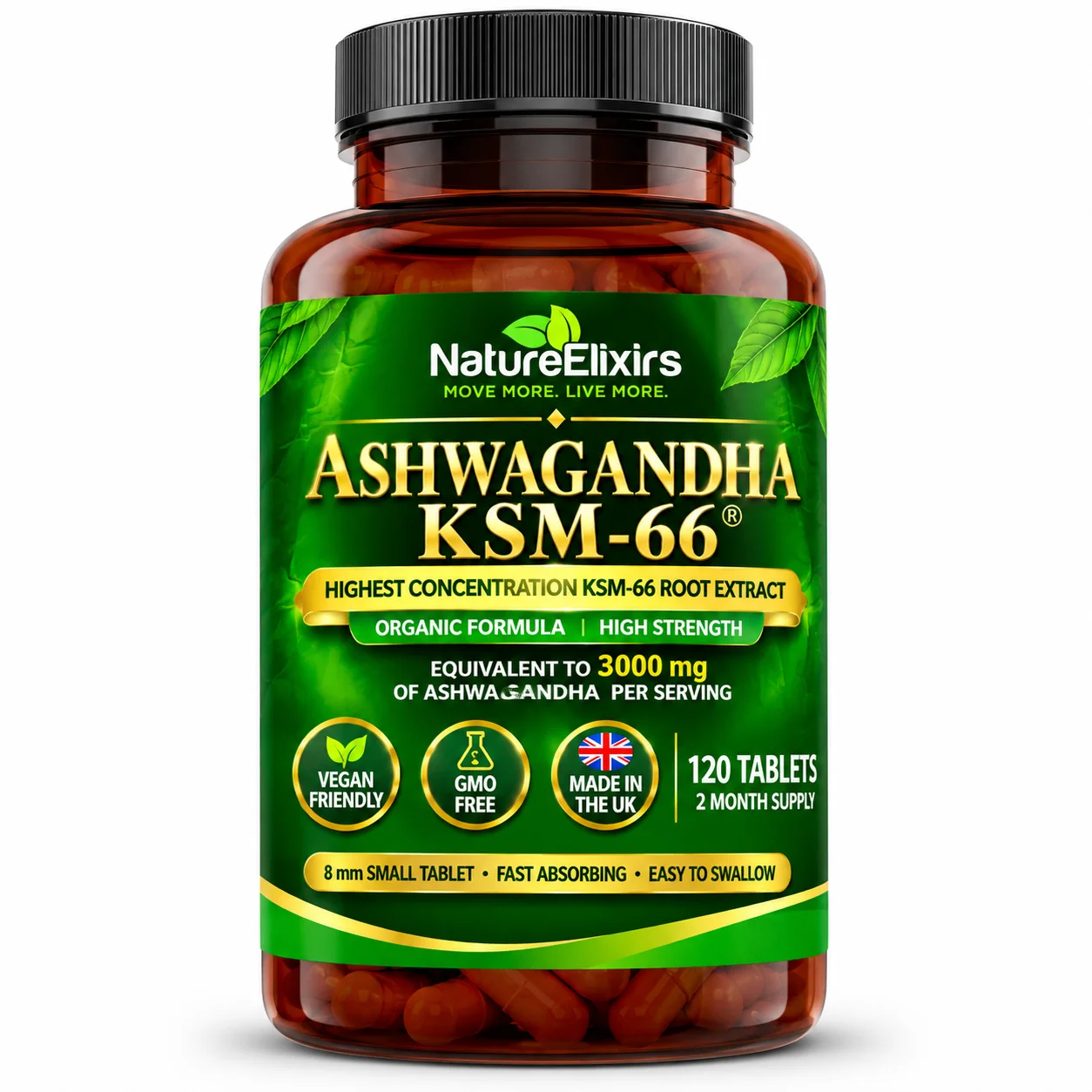
It is a simple formula: KSM-66 plus the two ingredients that form the tablet, microcrystalline cellulose and magnesium stearate. Nothing else is added. Each bottle carries a batch number and a best-before date, and the label lists the full directions and cautions.
If that is the kind of label you are looking for, you can see the full product details and order Nature Elixirs KSM-66 tablets here.
Frequently asked questions
Sources and how this guide was researched
Product figures in this guide come from the Nature Elixirs KSM-66 label and product page. Information about the KSM-66 extract comes from its producer and from published ingredient descriptions, and the regulatory sections draw on the Advertising Standards Authority, the Food Standards Agency and GOV.UK. Nature Elixirs publishes this guide and sells the product used as the worked example. It is general information, not medical advice.
- Nature Elixirs KSM-66® Ashwagandha Root Extract 300mg, 120 tablets: serving size, extract amounts, ingredients, directions and cautions from the product label
- KSM-66 Ashwagandha (Ixoreal Biomed), What is KSM-66: root-only, full-spectrum extract
- Ixoreal Biomed ingredient listing: extraction without alcohol or chemical solvents
- Stack3d, KSM-66 for year-round performance: root-only manufacture and standardisation to more than 5% withanolides by HPLC
- Nutraceuticals World (May 2026): withanolide concentrations in ashwagandha leaf and root
- SupplySide Supplement Journal, Ashwagandha regulation around the world: FAQ: India’s April 2026 root-only direction and UK status
- ASA ruling on Nutriburst Ltd (2024): stress and anxiety claims for a KSM-66 product
- Food Standards Agency, call for evidence on ashwagandha: the request for a Committee on Toxicity risk assessment
- GOV.UK, 8 September 2026 Committee on Toxicity meeting: third draft statement on ashwagandha
