Certificate of analysis · Batch SJ2509
Lab tested shilajit: our reports, in full
Every laboratory result behind Nature Elixirs Himalayan Shilajit Resin, with the original PDFs attached. Batch SJ2509 was screened for 4 heavy metals, 5 mycotoxins, 5 PAHs, 31 pyrrolizidine alkaloids, a full pesticide multi-residue panel and 6 microbiological parameters by an ISO/IEC 17025-accredited laboratory.
Headline results for batch SJ2509
- Lead (Pb) <0.50 mg/kg GB maximum 3.0 mg/kg Below LOQ
- Cadmium (Cd) <0.20 mg/kg GB maximum 1.0 mg/kg Below LOQ
- Mercury (Hg) <0.02 mg/kg GB maximum 0.10 mg/kg Below LOQ
- Arsenic (As), total 0.98 mg/kg No GB maximum is set for arsenic in supplements. The report states a second figure of 0.70 mg/kg. Detected — read the note
“<” means the parameter was below the laboratory's limit of quantification — the lowest amount the method can reliably measure. It does not mean zero. Bars show that upper bound as a share of the GB legal maximum.
Overview
What is lab tested shilajit?
Lab tested shilajit is a resin that has been independently analysed by a laboratory to examine its composition and screen for contaminants, rather than relying solely on a brand's own description of the product.
A proper laboratory analysis for shilajit typically covers fulvic acid and broader compositional markers, mineral or ash content, and – critically – a screen for contaminants such as heavy metals, microbial organisms, pesticide residues and mycotoxins. A report is evidence about the specific sample and parameters that were actually tested: it does not, by itself, prove that every characteristic of a product is ideal, or that every individual jar has been separately examined. Without any laboratory documentation at all, however, there is no independent way to check whether a shilajit product matches what its label claims – which matters for pure shilajit resin UK buyers are purchasing online, where the product cannot be physically inspected before purchase.
Overview
What is a shilajit certificate of analysis?
A shilajit certificate of analysis, or COA, is a formal document issued by a testing laboratory that records the results of tests carried out on a specific sample – a documented record rather than a general assurance.
Shilajit forms naturally over long periods in mountain rock, and its composition can vary depending on origin, altitude, the specific batch and purification method. A COA replaces a general claim with numerical data tied to a named sample and laboratory, which is what allows a customer to assess the evidence rather than take a marketing statement on trust. For anyone looking to buy pure Himalayan shilajit in the UK, an actual, inspectable report is one of the most useful things to look for.
Overview
What should a shilajit lab report include?
A thorough report should be evaluated against its testing scope and methodology, and relevant risks, rather than a fixed checklist – but a comprehensive report will typically cover the following.
- Fulvic acid percentage, analysed using the laboratory's specified method. Because methods differ between laboratories, percentages are not always directly comparable, and a higher figure alone is not proof of a more potent product.
- Mineral or ash composition, reflecting the parameters included in that specific analysis rather than necessarily every element shilajit may contain.
- Heavy metal testing – lead, mercury, arsenic and cadmium, stated as a measured result against a reporting limit rather than a simple pass or fail.
- Microbial testing, relevant given shilajit is dissolved in water or tea and consumed.
- Batch or sample identification, connecting the report to a specific production run so a customer can check the document describes the jar in front of them.
- Laboratory identity, method and reporting limits – the name of the laboratory, the method used for each parameter, and the limit each result is measured against.
Brands that publish these documents openly allow that level of scrutiny. If a seller cannot provide a COA for the batch currently on sale, that is worth asking about before buying.
Overview
Why lab tested shilajit matters in the UK
Shilajit is sold in the UK as a food supplement rather than a medicine. Supplements are subject to general food-safety and labelling law, but individual products are not pre-approved before sale the way medicines are, which places real responsibility on brands to test and document their own products.
Is shilajit lab tested by default? No. Some sellers import shilajit in bulk and repackage it with little or no independent verification of the specific consignment, and because shilajit passes through collection, purification and packaging before reaching a customer, there are several points where inconsistency could occur. Testing the finished, packaged product is the most direct way to check for this, though any single test always applies to a specific sample rather than to every jar individually.
Choosing lab tested shilajit means choosing a product with documented evidence behind it rather than an unverified label claim – a meaningful difference for anyone using shilajit as part of a daily routine. Read more about our approach to sourcing and testing.
Overview
Buy Lab Tested Shilajit Resin in the UK
Finding a reliable source when you decide to buy pure Himalayan Shilajit in the UK can feel overwhelming given how many options exist online. The key is to prioritise brands that are transparent about their sourcing, offer genuine resin rather than diluted powders, and publish their Shilajit certificate of analysis for customers to review. These three criteria alone will help you filter out a significant proportion of low-quality products.
Nature Elixirs offers lab tested Shilajit resin with UK-friendly delivery, transparent product information, and independently verified quality documentation. Each order is dispatched directly to your door and supported by clear information about the product’s origin, purification process, and test results. Exploring Shilajit benefits is much easier when you can do so with full confidence in the quality of what you are taking. Visit natureelixirs.com to view the current product range, read about the benefits of Himalayan Shilajit, and access the full certificate of analysis for the latest batch.
01 · Results
Full test register: batch SJ2509
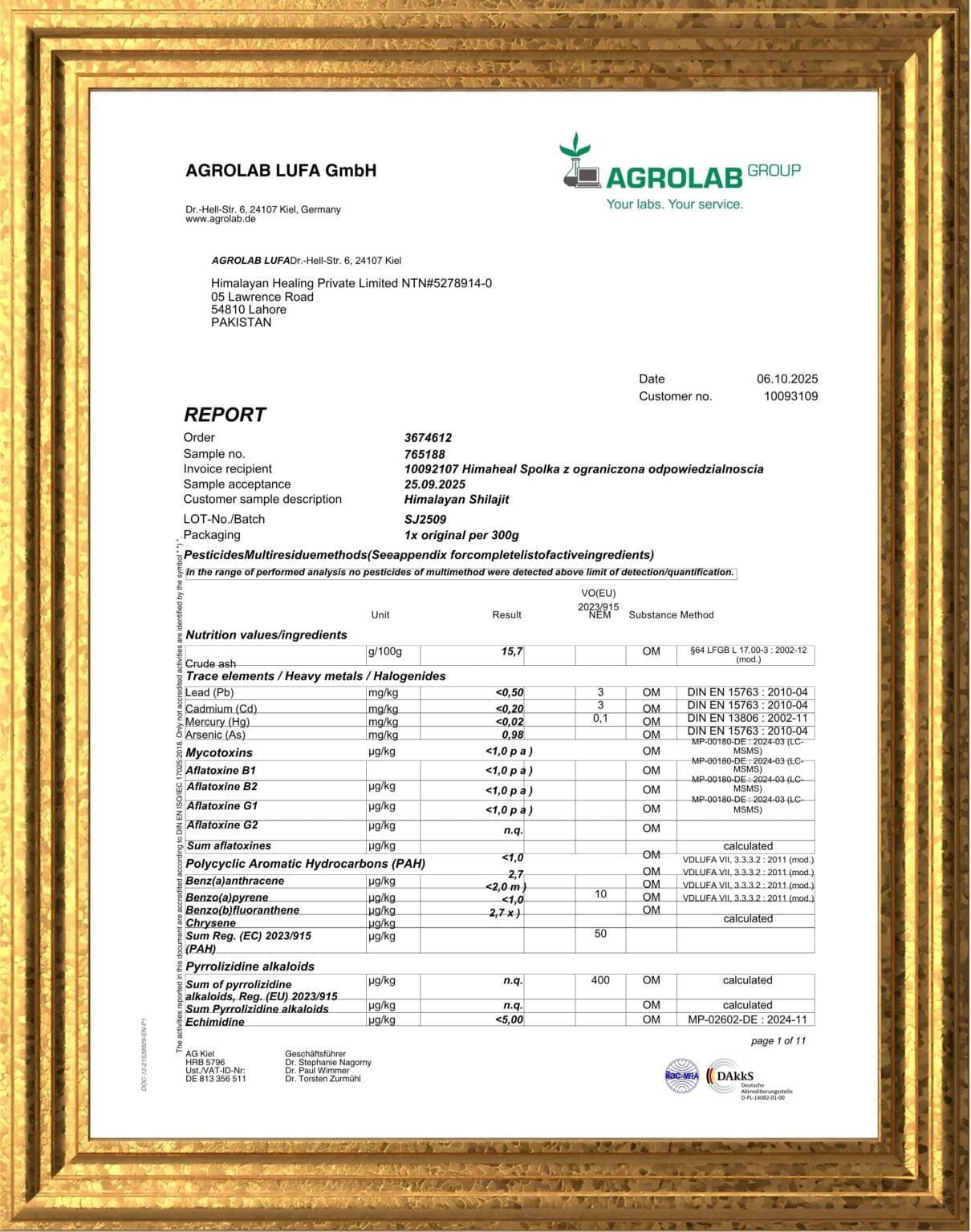
Every parameter AGROLAB LUFA measured on batch SJ2509, transcribed from the report dated 6 October 2025. Nothing is summarised away: where a result was below the limit of quantification we print the limit, and where something was detected we print the number.
| Parameter | Result | Limit applied | Status |
|---|---|---|---|
| Heavy metals & composition — mg/kg unless stated | |||
| Lead (Pb)DIN EN 15763 | <0.50 | 3.0 (GB) | Below LOQ |
| Cadmium (Cd)DIN EN 15763 | <0.20 | 1.0 (GB) | Below LOQ |
| Mercury (Hg)DIN EN 13806 | <0.02 | 0.10 (GB) | Below LOQ |
| Arsenic (As), totalDIN EN 15763 · uncertainty 55% | 0.98 | None set | Detected |
| Crude ash§64 LFGB L 17.00-3 · uncertainty 7% | 15.7 g/100 g | n/a | Measured |
| Mycotoxins — µg/kg, LC-MS/MS | |||
| Aflatoxin B1 | <1.0 | — | Below LOQ |
| Aflatoxin B2 | <1.0 | — | Below LOQ |
| Aflatoxin G1 | <1.0 | — | Below LOQ |
| Aflatoxin G2 | <1.0 | — | Below LOQ |
| Sum of aflatoxinscalculated | Not quantifiable | — | Below LOQ |
| Polycyclic aromatic hydrocarbons (PAHs) — µg/kg | |||
| Benz(a)anthracene | <1.0 | — | Below LOQ |
| Benzo(a)pyreneuncertainty 30% | 2.7 | 10 | Below limit |
| Benzo(b)fluoranthene | <2.0 | — | Below LOQ |
| Chrysene | <1.0 | — | Below LOQ |
| Sum of 4 PAHsReg. (EU) 2023/915 | 2.7 | 50 | Below limit |
| Pyrrolizidine alkaloids — µg/kg, 31 compounds | |||
| All 31 individual compoundsEchimidine, Heliotrine, Lasiocarpine, Senecionine, Senkirkine and 26 others | <5.00 to <25.0 | — | All below LOQ |
| Sum of pyrrolizidine alkaloidsReg. (EU) 2023/915 | Not quantifiable | 400 | Below limit |
| Pesticides — mg/kg, multi-residue screen | |||
| Pesticide multi-residue panelFull active-ingredient list on report pages 5–8; most LOQs 0.01 mg/kg | None detected | LOD/LOQ | Not detected |
| Microbiology | |||
| Aerobic mesophilic plate countDIN EN ISO 4833-1 | <100 cfu/g | LOD | Below LOD |
| Escherichia coliDIN EN ISO 16649-3 | Not detected in 1 g | — | Not detected |
| YeastsISO 21527-2 | <100 cfu/g | LOD | Below LOD |
| MouldsISO 21527-2 | <100 cfu/g | LOD | Below LOD |
| Salmonella spp.ISO 6579-1 | Not detected in 25 g | — | Not detected |
| Listeria monocytogenesNordVal cert. 022, ref. EN ISO 11290-1 | Not detected in 25 g | — | Not detected |
LOQ = limit of quantification. LOD = limit of detection. GB maximum levels for lead, cadmium and mercury in food supplements come from assimilated Regulation (EC) No 1881/2006. The Salmonella method does not include S. Typhi or S. Paratyphi, which the laboratory notes are rarely found in food.
“According to the extent of the analysis the sample complies with the requirements of Regulation (EU) 2023/915, food supplements.”
AGROLAB LUFA report, page 3. This is the laboratory's assessment against EU contaminant limits for the tests it ran — it is not a government approval of the product, and arsenic was excluded from it.02 · Documents
The original laboratory reports
Three reports, three different jobs. Open the PDFs rather than taking the tables above on trust.

03 · Interpretation
Understanding the arsenic result
The current AGROLAB report records total arsenic in two places: 0.98 mg/kg in the results table and 0.70 mg/kg in the report remarks. Because these figures differ, we have not reinterpreted or selectively presented the laboratory document. Both figures are reproduced here exactly as reported, together with the laboratory's stated measurement uncertainty.
The report gives a measurement uncertainty of 55% for arsenic, the widest of any parameter it measured, and no maximum level is set for arsenic in food supplements in Great Britain. It also notes that only inorganic arsenic is toxicologically relevant, and recommends that this fraction be assessed separately from total arsenic. That separate analysis is therefore being incorporated into the testing programme for a future batch. The important point for customers is that this page reproduces the laboratory's documentation rather than converting one result into a marketing claim.
Why arsenic results should be compared carefully
Arsenic numbers from different shilajit brands should not be treated as automatically equivalent. A meaningful comparison needs to account for the sample tested, the batch, the laboratory, the analytical method, the units, the reporting limit, the measurement uncertainty, whether the figure represents total or a specific arsenic fraction, and the date and scope of the report. Publicly available shilajit laboratory reports from different brands can show different arsenic results, and that does not, by itself, establish that one product is safer than another, because the reports may relate to different samples, laboratories, methods and reporting conditions.
The purpose of publishing our report is to let you examine the actual documentation rather than rely on a simplified “lowest number wins” comparison.
04 · Context
Heavy metals in shilajit: why this testing exists
Shilajit forms in rock over centuries, so metals from the surrounding geology end up in the raw material. This is the single most-researched safety concern with shilajit, and it is the reason a resin without a current lab report is a genuine gamble rather than a cautious purchase.
Reviews of shilajit consistently flag that unprocessed or poorly purified material can carry heavy metals, mycotoxins and free radicals. A 2025 analysis in BMC Chemistry reported elevated thallium in several commercial shilajit supplements, and a 2016 survey of samples from Gilgit and Chellas in Pakistan found lead, chromium and cobalt present, though within WHO limits. Independent testing by ConsumerLab in 2024 took eight popular shilajit products and found the opposite picture on contamination — lead, cadmium, arsenic and mercury were all beneath levels of concern at a single daily dose — while fulvic acid content varied between products by a factor of roughly 320.
Two conclusions follow, and both matter more than any brand's marketing. Contamination is a real and documented risk in this category, but it is not universal, so a product is not suspect simply for being shilajit. And because the variation between products is enormous, the only thing that tells you about the jar in front of you is a report on the batch in that jar.
Testing scope and future additions
Laboratory testing is defined by the parameters included in a given analytical programme. The current report covers the parameters set out in the published laboratory documentation above. Nature Elixirs is expanding future testing to include additional parameters of relevance to shilajit quality, including inorganic arsenic specifically and thallium, and the results will be published here through the same process as the reports already on this page.
05 · Interpretation
What the numbers mean per serving
Concentrations in mg/kg describe the resin. What reaches you depends on how much you take. At our suggested 250–500 mg daily, the figures work out as below.
| Metal | Report result | At 250 mg | At 500 mg |
|---|---|---|---|
| Lead | <0.50 mg/kg | under 0.13 µg | under 0.25 µg |
| Cadmium | <0.20 mg/kg | under 0.05 µg | under 0.10 µg |
| Mercury | <0.02 mg/kg | under 0.005 µg | under 0.01 µg |
| Arsenic (total) | 0.98 mg/kg | about 0.25 µg | about 0.49 µg |
| Arsenic (alt. figure) | 0.70 mg/kg | about 0.18 µg | about 0.35 µg |
Calculated as concentration × serving weight. These are arithmetic conversions of the reported figures, not a safety assessment, and total arsenic is not the same measure as the inorganic arsenic that toxicologists treat as relevant. If you are pregnant, breastfeeding, taking medication or managing a health condition, talk to your GP or pharmacist before taking any supplement.
06 · Scope
What we test for, beyond the usual four
Most shilajit lab reports you will find online cover four heavy metals and sometimes microbiology. Batch SJ2509 was screened across six categories. Breadth is where our testing genuinely differs — not in having lower numbers than everyone else, which we have no way to verify.
-
04 parameters
Heavy metals
Lead, cadmium, mercury and arsenic. The standard panel, and the one nearly every brand reports.
-
05 parameters
Mycotoxins
Aflatoxins B1, B2, G1, G2 and their sum. Mould toxins that matter for an organic material stored and shipped over long distances.
-
05 parameters
PAHs
Polycyclic aromatic hydrocarbons, which form as organic matter breaks down under heat and pressure — exactly how shilajit itself forms.
-
31 compounds
Pyrrolizidine alkaloids
Plant toxins picked up from surrounding vegetation. Rarely tested for in this category, and the largest single panel on our report.
-
Full panel
Pesticide residues
A multi-residue screen running to four pages of active ingredients and metabolites, most at a 0.01 mg/kg limit of quantification.
-
06 parameters
Microbiology
Total plate count, yeasts, moulds, E. coli, Salmonella and Listeria monocytogenes — relevant to anything you dissolve and drink.
07 · Traceability
From the source to your jar
Nature Elixirs is not a brand that buys finished resin on the open market and puts a label on it. Himalayan Healing, the operation that collects and purifies the resin in Pakistan, is our own facility. The name on the laboratory paperwork is ours because the production is ours.
That matters for what we can actually tell you. Most UK shilajit brands are several steps removed from the mountain: they buy from a trading company, receive whatever documentation comes with the consignment, and have no way to answer a question about how the material was purified. We can trace a jar back to the batch, the batch back to the production run, and the production run back to the collection.
Collection
Raw resin is collected at altitude in the Himalayan range and brought down for processing.
Our operationPurification
The raw material is filtered and purified at our facility in Pakistan, then dried to a finished resin.
Our operationBatch production
Finished resin is prepared as a production batch of roughly 2,500 jars and given a batch number — SJ2509 for the current run.
Our operationIndependent testing
A sample goes to an accredited third-party laboratory. We do not run these tests ourselves, and that is the point of them.
Third partyRelease
The batch is only released once the report is in and reviewed. If a result failed, the batch would not ship.
Our operationUK fulfilment
Jars are stocked and dispatched from London by Nature Elixirs Ltd, the UK company you buy from.
Our operation
Batch tested is not jar tested. A laboratory tests a representative sample from a production run of about 2,500 jars, and the report describes that sample. That is standard practice for food supplements, and it is why the batch number matters. We would rather say this plainly than let “lab tested” imply that someone opened your jar.
Buying guidance
How to identify authentic Himalayan shilajit
With so many products on the market, distinguishing genuine pure Himalayan shilajit resin from lower-quality alternatives is easier when you know what documentation to look for.
- Independent laboratory testing – an actual certificate of analysis available on the website or on request, not a badge with nothing behind it.
- Transparent sourcing – a brand that can say clearly where and how its material is collected and processed.
- Resin form – the most concentrated and least processed form, and the easiest to visually inspect and match against a lab report. This doesn't make capsules or powder automatically inferior; it means resin gives you more to compare.
- A described purification process – a brand that can explain its own method, rather than a generic industry description.
- A published certificate of analysis, batch by batch, rather than a claim that testing "has taken place".
Check that any report names a laboratory, states a batch or sample number, and carries a recent test date. A report with no batch number, or one several years old, may not represent the product currently on sale. View our certificates and supporting documentation.
08 · Limits
What a certificate of analysis can and can't prove
A COA is the strongest evidence a shilajit brand can offer about safety and composition. It is also narrower than most marketing implies, and knowing the edges is what lets you compare brands properly.
It does establish
- Which sample and batch was tested, by which laboratory, and when
- The analytical method behind every individual result
- Measured contaminant levels, and the detection limits that bound them
- Whether the laboratory assessed the sample against a named regulation
- What the laboratory's accreditation does and does not cover
It does not establish
- That every jar in the batch was individually tested
- That the next batch will return the same figures
- That anything below a limit of quantification is absent
- That contaminants outside the tested panel are absent
- Any health effect whatsoever — testing measures content, not outcomes
- Government or regulatory approval of the product
Shilajit is sold in the UK as a food supplement, not a medicine. No laboratory report can show that a food supplement diagnoses, treats, cures or prevents a disease, and we make no such claim for ours.
09 · Composition
Fulvic acid and trace minerals: naturally variable by batch
Nature Elixirs Shilajit is specified as containing more than 60% fulvic acid, with some batches reaching approximately 75%, based on our IAS Laboratories documentation. Because shilajit is a naturally derived material, composition can vary between batches, and any figure should be understood in the context of the specific sample and analytical method used.
Fulvic acid is one of the most commonly analysed markers in shilajit, but percentages are not always directly comparable between reports. Different laboratories use different methods and reference standards, and the same resin can return a different figure depending on which is used — ConsumerLab's 2024 testing found fulvic acid content varying roughly 320-fold across eight shilajit products, which illustrates how wide that spread can be. A figure with a named method attached, on an actual report, tells you a great deal more than the same figure on its own on a label.
The IAS Laboratories report provides laboratory analysis of the sample submitted for testing, covering fulvic acid, humic acid, sulfur, moisture and organic matter. You can review the original IAS report directly rather than relying only on our summary of it.
Naturally occurring minerals and trace elements
Shilajit is a naturally complex mineral-organic substance containing a broad range of mineral and trace-element constituents. Published research has identified numerous elements in shilajit, although the exact profile varies according to geographical origin, sample and analytical method. Our “85+ trace minerals” specification refers to this established compositional understanding of shilajit as a substance, together with our own product specification — it describes the broader mineral profile associated with the material, rather than a claim that a single routine safety panel quantifies all 85+ elements individually. The crude ash result of 15.7 g/100 g on our AGROLAB report is a general indicator of overall mineral content, consistent with that broader profile.
10 · Verification
How to check this report yourself
Everything on this page is checkable without taking our word for any of it. Run the same six steps on any shilajit brand you are considering.
Match the batch to your jar
The batch number on the report should match the one printed on your packaging. Ours is SJ2509. A report with no batch number describes some shilajit, not necessarily yours.
Confirm the laboratory exists
AGROLAB LUFA GmbH, Dr.-Hell-Str. 6, Kiel. The address, the company registration and the accreditation statement are all on the report and all independently searchable.
Check the accreditation covers the work
The report states its activities are accredited to DIN EN ISO/IEC 17025:2018, and marks any non-accredited activity separately. Accreditation applies to the testing, not to information the customer supplied.
Read the dates
Testing ran 25 September to 6 October 2025, and the batch was released after that. A report dated after the product went on sale is a warning sign.
Read results, not verdicts
Compare each measured figure against the limit printed beside it. “Passed” on its own is not a result, and a “<” value is an upper bound rather than a zero.
Ask us for anything missing
If your batch is not the one published here, or you want a parameter we have not listed, email info@natureelixirs.com and we will send what exists or tell you plainly that it does not.
11 · Certificates
Certificates, and what they actually cover
A laboratory report says what was found in a sample. A certificate says a management system was audited against a standard. They answer different questions, and a certificate is not a substitute for a test result.
| Standard | What it covers | Relevance here |
|---|---|---|
| HACCP | Hazard analysis and critical control points across food production | Food safety system |
| ISO 9001:2015 | Quality management. Scope codes EA 03 (food products) and EA 29 (wholesale and retail trade) | Quality system |
| ISO 22000:2018 | Food safety management. Food category CIV, processing of ambient-stable products | Food safety system |
| ISO 22716:2007 | Good manufacturing practice for cosmetics | Not a food standard |
These certificates are held at production level, not by Nature Elixirs Ltd as a UK entity, so we do not describe Nature Elixirs itself as “ISO certified”. ISO 22716 is included for completeness but it is a cosmetics GMP standard, and we do not present it as evidence about a food supplement. Holder, certificate number, scope and validity dates are on each document: view the certificates.
12 · The product
The resin these reports describe
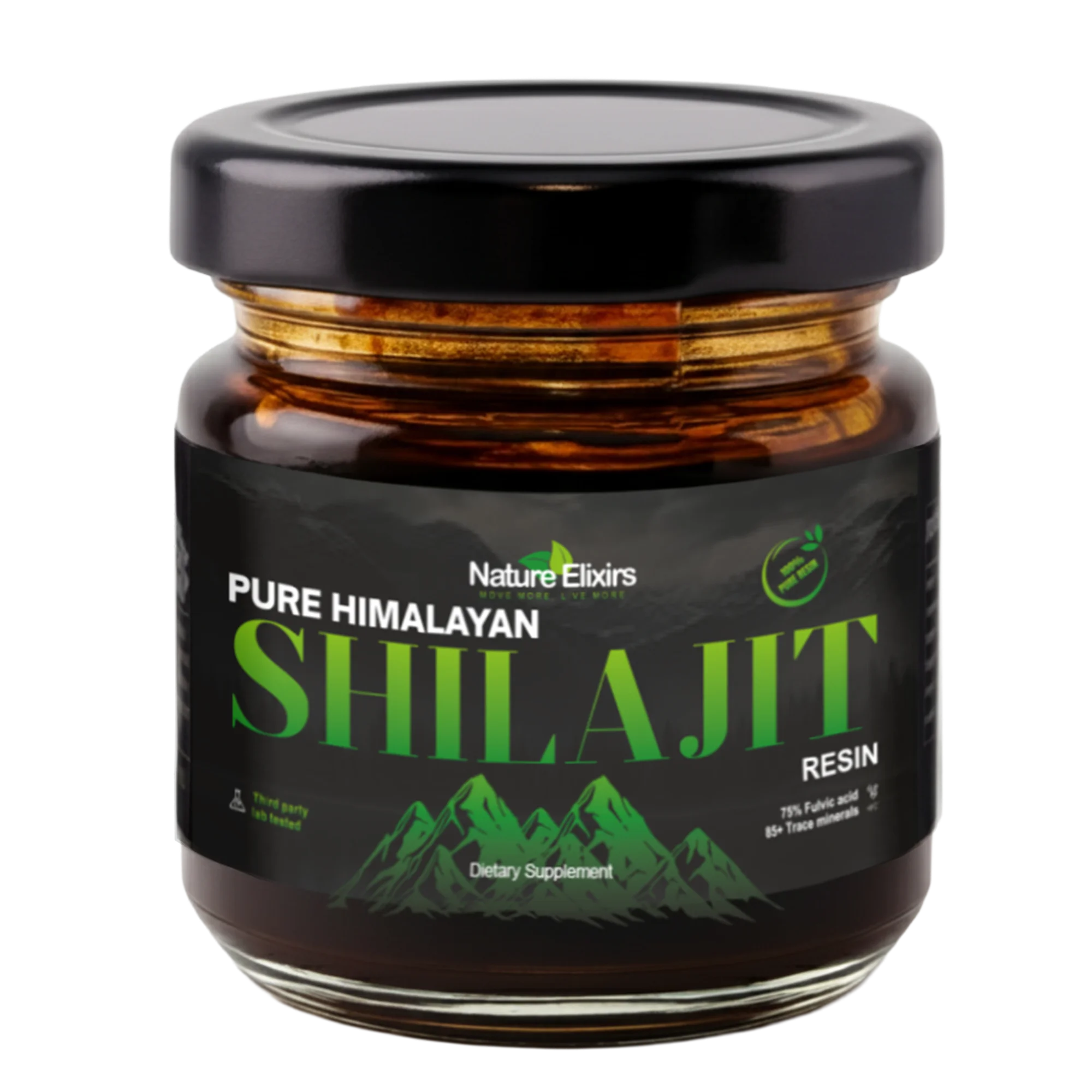
Everything above documents one product: Nature Elixirs Pure Himalayan Shilajit Resin, 30g, £39.99, currently shipping from batch SJ2509. If the evidence on this page answers your questions, this is the jar it belongs to.
| Detail | Specification | Evidenced by |
|---|---|---|
| Format | Soft resin, 30g glass jar with measuring spatula | Product |
| Price | £39.99, about £1.33 per gram | Product |
| Suggested use | 250–500 mg daily in warm water; start at 250 mg. How to use it | Product |
| Jar duration | About 120 servings at 250 mg, about 60 at 500 mg — roughly 33p to 67p a day | Calculated |
| Current batch | SJ2509, documented in full in the register above | Lab report |
| Contaminant screening | Heavy metals, mycotoxins, PAHs, 31 pyrrolizidine alkaloids, pesticide multi-residue panel, 6 microbiological parameters | Lab report |
| Origin | Collected and purified at our own facility in Pakistan; full chain above | Our operation |
| Stated composition | More than 60% fulvic acid, some batches approx. 75%; 85+ trace minerals. Full explanation above | Specification |
| Seller & delivery | Nature Elixirs Ltd, dispatched from London by tracked Royal Mail | Product |
| Returns | 28 days from receipt, per our returns policy | Policy |
How to use it
Take a pea-sized portion of the resin – roughly 250–500 mg – dissolved in warm (not boiling) water, herbal tea or warm milk, once or twice daily. Start with a smaller amount and build up gradually. If you are new to shilajit, pregnant or breastfeeding, or taking medication, speak to your GP or pharmacist first. Full guidance is on our how to use shilajit page.
A good fit if you
- Want the contaminant screening to go wider than the usual four heavy metals
- Want to read the batch report before paying, not after
- Want resin rather than capsules or gummies
- Want a UK seller with a written returns window and a traceable production chain
Why customers choose Nature Elixirs
- Original laboratory documentation, not just a testing claim
- Batch-specific results, named laboratories and analytical methods
- Contaminant screening across the published laboratory scope
- Direct access to the original documents behind every figure on this page
- Our own facility handling collection and purification, giving direct traceability
If you're comparing brands rather than reading documents, our UK shilajit buying guide sets out the checks to run on anyone's product, ours included. If you're deciding between formats first, see resin versus capsules versus powder.
If your priority is knowing what you are buying before you buy it, that is what this page is for: the product, the documentation, and the information needed to evaluate both for yourself.
13 · Questions
Questions about shilajit lab testing
Can I see the laboratory report for Nature Elixirs shilajit?
Yes. The report for the batch currently shipping, SJ2509, is downloadable in full on this page, and the batch number is printed on the base of the jar so you can check the two match. If you want the report for a different batch, email info@natureelixirs.com with the number from your packaging and we will send it.
What does a shilajit certificate of analysis show?
It shows what a specific sample was tested for, which laboratory performed the analysis, which methods were used, the measured results and the reporting limits behind them. It is evidence about that sample, tied to a named batch, rather than a general assurance.
Does a shilajit COA prove every jar was tested?
No. A COA describes a specific sample taken from a production batch, not every individual unit sold under that batch. This is standard practice for food supplements generally, and it is why the batch number on your jar – matched against the batch named on the report – matters more than the phrase "lab tested" on its own.
How should I interpret arsenic results in a shilajit report?
Look at the actual figure, the method, the reporting limit and any measurement uncertainty, and check whether it represents total or inorganic arsenic. Shilajit is rock-derived, so some naturally occurring arsenic is a normal finding rather than automatic evidence of a problem. Our own report gives two figures for total arsenic, 0.98 and 0.70 mg/kg, and we explain both above rather than presenting a single simplified number.
Does higher fulvic acid automatically mean better shilajit?
Not reliably, because the figures are rarely comparable. Different laboratories use different analytical methods, and the same resin can return materially different percentages depending on which is used, so a brand quoting a bigger number may simply be quoting a more generous method. Treat any percentage without a named method attached as marketing rather than measurement.
Why can fulvic acid percentages differ between laboratories?
Different laboratories can use different methods and reference standards for measuring fulvic acid. ConsumerLab's 2024 testing found fulvic acid content varying roughly 320-fold across eight shilajit products, which illustrates how wide that spread can be even before accounting for genuine differences between products.
What heavy metals should be tested in shilajit?
Lead, mercury, arsenic and cadmium as a minimum, since shilajit forms in mineral-rich rock and can naturally contain trace amounts of each. A useful report states the measured result and method for all four against the relevant reporting limit, rather than a single "heavy metals tested" statement.
What other contaminants should a shilajit laboratory report check?
Beyond heavy metals, a broader report can include mycotoxins, polycyclic aromatic hydrocarbons, pyrrolizidine alkaloids, pesticide residues and microbiology. Our current report covers all of these; many published shilajit reports cover heavy metals alone, which is worth knowing when comparing testing scope between brands.
How can I verify a shilajit laboratory report?
Check that it names a laboratory, states a batch or sample number matching your product, carries a recent test date, and lists the actual measured results and methods rather than a pass/fail summary. See our full verification checklist above.
How often should shilajit batches be tested?
Each production batch should be sampled and tested before release. Ours are roughly 2,500 jars per batch, so testing frequency follows production rather than a calendar; when a new report is issued, the register on this page is rewritten from that document.
14 · Sources
Documents and sources
Last reviewed: . This page is reviewed and updated whenever new laboratory documentation becomes available.
- AGROLAB LUFA GmbH test reportOrder 3674612, sample 765188, batch SJ2509, 6 October 2025. Source for the full test register.
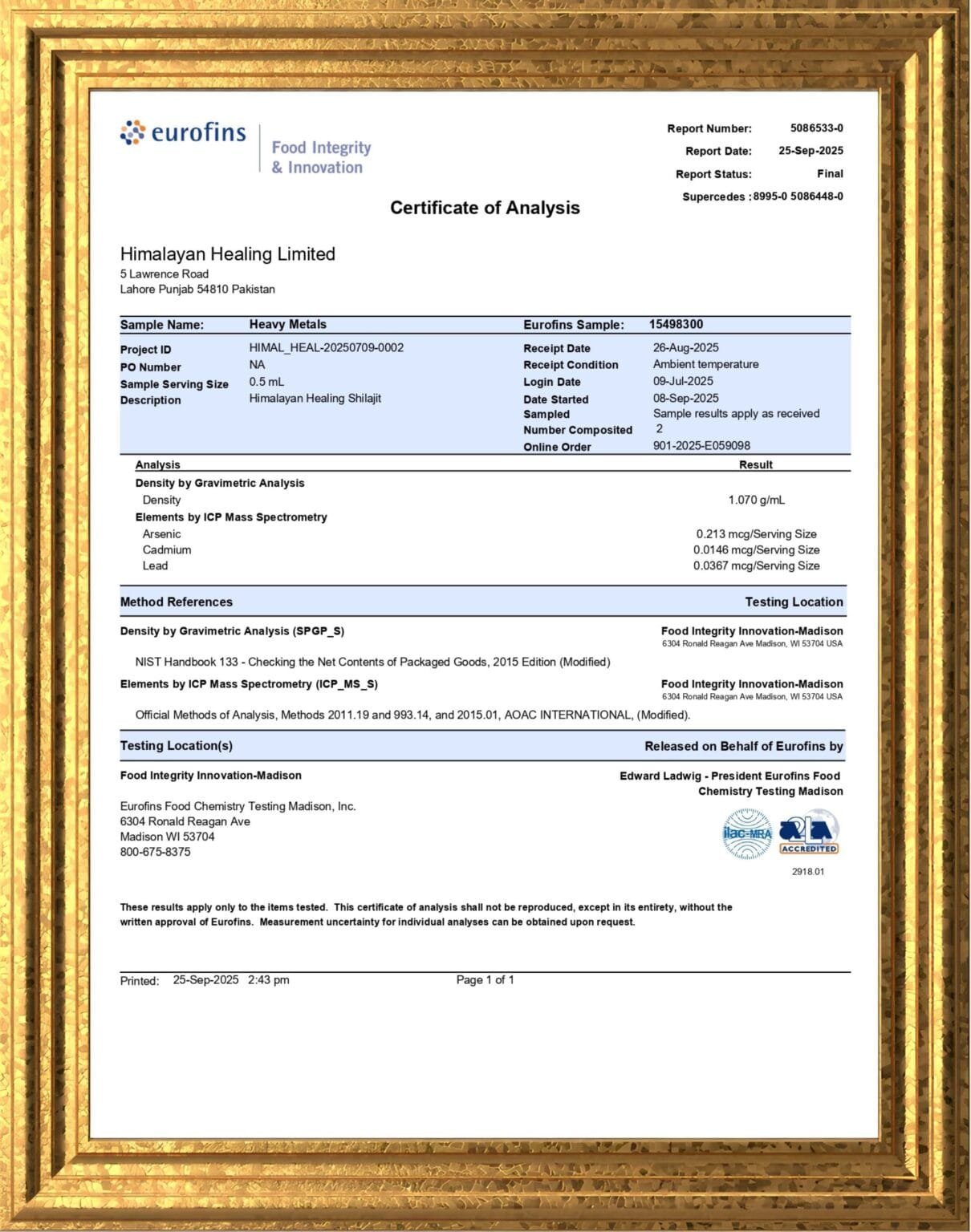
- Eurofins certificate of analysisReport 5086533-0, sample 15498300, 25 September 2025. Per-serving heavy metal figures.
- IAS Laboratories sample resultsWork order 24K0027, lab ID 24K0027-01, received 1 November 2024. Composition parameters.
- Regulation (EC) No 1881/2006, as assimilated in Great BritainGB maximum levels for lead, cadmium and mercury in food supplements.
- Great Britain nutrition and health claims registerWhich health claims may lawfully be made on food in Great Britain.
- ConsumerLab, shilajit supplement testing, 2024Independent testing of eight shilajit products for fulvic acid and heavy metals.
- United Kingdom Accreditation ServiceFor checking what a laboratory's accreditation covers.
Related reading. For choosing between brands rather than reading our documents, see our UK shilajit buying guide. For what the research does and does not show about effects, see our research summary and safety guide. To tell genuine resin from fakes at home, see real versus fake shilajit.
You've read the report. The jar is here.
Pure Himalayan Shilajit Resin, 30g, from batch SJ2509 — the batch documented on this page. Review the reports, examine the results, and decide for yourself. Dispatched from London with a 28-day returns window.