
Documentation · Shilajit certificates UK
Shilajit Certificates UK: Our Quality Documents, Explained
Certificates and lab reports answer different questions. The food-safety and quality certificates held by our production facility show its systems were audited against named standards. Our batch lab reports show what an accredited laboratory found in the resin itself. You'll find both here, with a plain guide to reading them and checking them against your jar.
01 · Two kinds of document
Is a Shilajit certificate the same as a lab report?
No. A certificate shows that a management system – food safety, quality or manufacturing practice – was audited against a standard such as ISO 22000. A Certificate of Analysis (COA) is a laboratory report on a specific sample, listing what was tested, the methods and the results. Neither replaces the other.
| Management-system certificate | Certificate of Analysis (lab report) | |
|---|---|---|
| Issued by | A certification body, after auditing a facility | An independent testing laboratory |
| Answers | Does the facility run controlled food-safety and quality systems? | What was found in this particular sample? |
| Tied to | An organisation, a site and a defined scope | A named sample and production batch |
| Contains test results? | No | Yes – measured values, methods and reporting limits |
| Where ours are | On this page | Lab Reports page |
02 · The documents
The certificates held across our production chain
Our resin is collected in the Himalayan range and purified, batched and packed at our own production facility in Pakistan. The certificates below are held at that production level. They aren't held by Nature Elixirs Ltd as a UK company, so we don't describe Nature Elixirs itself as "ISO certified" – we'd rather be exact about who holds what.
-
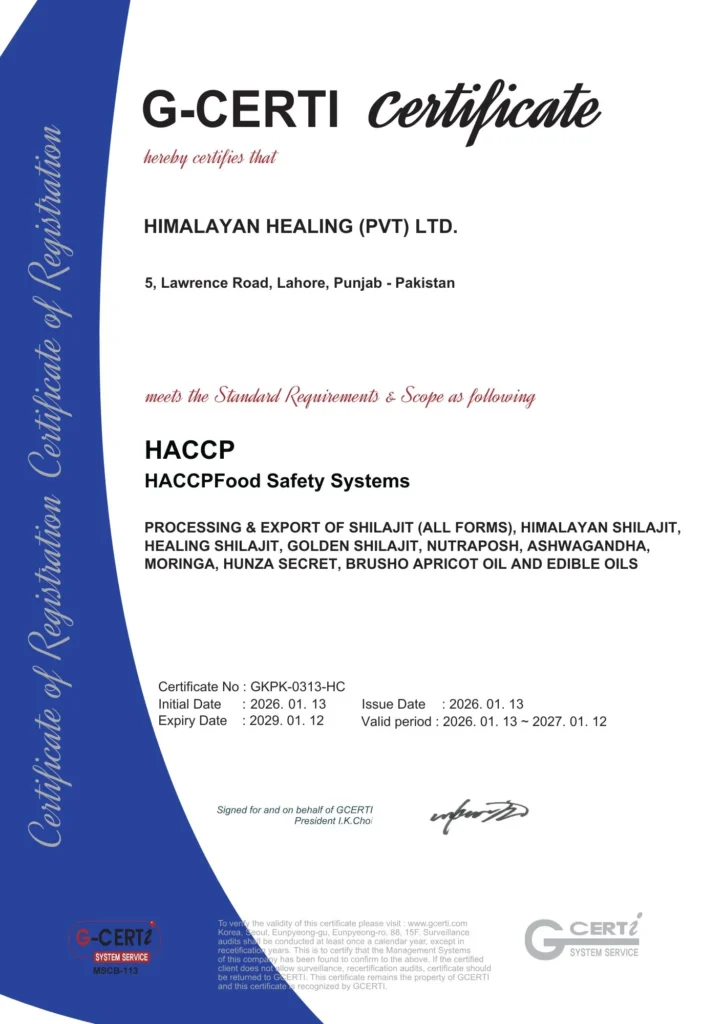
HACCP certificate Open full size -

Management-system certificate Open full size -

Management-system certificate Open full size -

Management-system certificate Open full size
These images are reduced-size copies. If you need the full-resolution document for a particular certificate, email info@natureelixirs.com.
03 · Scope
What HACCP and each ISO standard actually covers
HACCP and ISO 22000 are food-safety systems, ISO 9001 is quality management, and ISO 22716 is good manufacturing practice for cosmetics. Each is evidence about how a facility is run, not a test result for the resin.
| Standard | What it covers | Relevance to a food supplement |
|---|---|---|
| HACCP | Hazard analysis and critical control points across food production | Food-safety system |
| ISO 9001:2015 | Quality management. Scope codes EA 03 (food products) and EA 29 (wholesale and retail trade) | Quality system |
| ISO 22000:2018 | Food safety management. Food category CIV, processing of ambient-stable products | Food-safety system |
| ISO 22716:2007 | Good manufacturing practice for cosmetics | Not a food standard – listed for completeness |
We include ISO 22716 because the facility holds it, but we don't present a cosmetics standard as evidence about a food supplement. For questions about what the resin contains, the laboratory reports are the right documents.
04 · Certificate of Analysis
What is a Shilajit Certificate of Analysis?
A Certificate of Analysis is a document from a testing laboratory that records what a specific sample was tested for, the methods used and the measured results. For Shilajit, a useful COA names the laboratory, identifies the sample and batch, and gives actual numbers rather than a simple pass or fail.
Shilajit forms naturally in mountain rock, so its composition – and its contaminant profile – can vary with origin, batch and purification. A COA replaces a general claim with data tied to a named sample, which is what lets you judge the evidence yourself.
We publish three laboratory documents, each with a different job:
-
AGROLAB LUFA GmbH
The primary report for batch SJ2509: heavy metals, mycotoxins, PAHs, pyrrolizidine alkaloids, pesticides and microbiology. 11 pages, dated 6 October 2025.
-
Eurofins
Supporting heavy-metal figures expressed per serving rather than per kilogram, so they can't be set directly beside the AGROLAB results.
-
IAS Laboratories
Composition: fulvic acid, humic acid, sulfur, moisture and organic matter, from an earlier sample received in November 2024.
All three are on the Lab Reports page as original PDFs.
05 · Reading a COA
What to look for in a Shilajit COA
Check eight things: the laboratory's name, its accreditation, the sample and batch number, the dates, the test scope, the method behind each result, the reporting limits, and the actual measured values with any remarks.
Here's that checklist applied to our own primary report, so you can see what each item looks like on a real document.
- Laboratory identity
- An independent laboratory with a name and address you can look up.
- On our report: AGROLAB LUFA GmbH, Dr.-Hell-Str. 6, Kiel, Germany.
- Accreditation
- A statement of which testing is accredited, ideally to ISO/IEC 17025.
- On our report: accredited to DIN EN ISO/IEC 17025:2018, with any non-accredited activity marked separately.
- Sample and batch
- A sample number and a batch number you can match to your jar.
- On our report: sample 765188, batch SJ2509, received as 300 g of Himalayan Shilajit.
- Dates
- When testing ran and when the report was issued.
- On our report: tested 25 September to 6 October 2025; report dated 6 October 2025.
- Test scope
- Which contaminant groups were included. A heavy-metals-only report covers far less.
- On our report: heavy metals, mycotoxins, PAHs, 31 pyrrolizidine alkaloids, a pesticide multi-residue screen and six microbiological tests.
- Analytical methods
- A named method for each result.
- On our report: for example DIN EN 15763 for lead, cadmium and arsenic, DIN EN 13806 for mercury, ISO 6579-1 for Salmonella.
- Reporting limits
- The lowest level the method can measure. A "<" value means below that limit – not zero.
- On our report: lead <0.50 mg/kg, cadmium <0.20 mg/kg, mercury <0.02 mg/kg.
- Results and remarks
- Measured numbers, plus any remarks and measurement uncertainty from the laboratory.
- On our report: detected values are printed with the laboratory's remarks. The report includes a note on arsenic, which we explain in full on the Lab Reports page.
06 · Batches
Why batch testing matters for Shilajit
Shilajit is a natural material, so composition can differ from one batch to the next. A lab report only describes the sample tested, which is why it should name a batch you can match to the jar in your hand.
Our production batches are roughly 2,500 jars. The laboratory tests a representative sample from the batch, and the report describes that sample. That's standard practice for food supplements – and it means "batch tested" is the accurate phrase, not "every jar tested". We'd rather say that plainly than let a label imply someone opened your jar.
It also means an old report, however good, isn't evidence about the stock on sale today. A useful certificate set is current, batch-specific and easy to match.
07 · Our process
How Nature Elixirs documents each batch
Each production batch is sampled and sent to an accredited third-party laboratory before release, and we publish the report for the batch currently on sale.
-
Collection
Raw resin is collected at altitude in the Himalayan range.
Our operation -
Purification
The material is filtered and purified at our facility in Pakistan using a cold-water method, then dried to a finished resin.
Our operation -
Batch numbering
Finished resin is prepared as a production batch and given a number – SJ2509 for the current run.
Our operation -
Independent testing
A sample goes to an accredited laboratory. We don't run these tests ourselves; that's the point of them.
Third party -
Review and release
The batch is released only once the report is in and reviewed. If a result failed, the batch wouldn't ship.
Our operation -
UK dispatch
Jars are stocked and sent from London by Nature Elixirs Ltd, the UK company you buy from.
Our operation
| What | Document | Applies to |
|---|---|---|
| Heavy metals, mycotoxins, PAHs, pyrrolizidine alkaloids, pesticides, microbiology | AGROLAB LUFA GmbH report | Batch SJ2509 |
| Total mineral content (crude ash: 15.7 g per 100 g) | AGROLAB LUFA GmbH report | Batch SJ2509 |
| Heavy metals per serving | Eurofins certificate of analysis | Supporting data |
| Fulvic acid, humic acid, sulfur, moisture, organic matter | IAS Laboratories results | Earlier sample, received November 2024 |
We're adding inorganic arsenic and thallium to the testing programme for future batches, and those results will be published through the same process.
08 · Verification
How to verify the certificate for your batch
Find the batch number on the base of your jar, match it to the batch named on the laboratory report, then check the laboratory and its accreditation independently. If your batch isn't the one published, ask us for its report.
-
Find your batch number
It's printed on the base of the jar. The batch currently documented is SJ2509.
-
Match it to the report
The batch on the laboratory report should be the same number. A report without a batch number describes some shilajit, not necessarily yours.
-
Look up the laboratory
Search the laboratory's name and address, and check its accreditation with the national accreditation body – DAkkS for German laboratories, UKAS for UK ones.
-
Read the dates
Testing should be recent and should have finished before the batch went on sale.
-
Read the numbers, not just the verdict
Compare each result with the limit printed beside it. "Passed" on its own isn't a result.
-
Ask us for anything missing
Email info@natureelixirs.com with the number from your jar. We'll send the report for that batch, or tell you plainly if something you've asked for doesn't exist.
09 · Limits
What a Shilajit certificate does and doesn't mean
It does show
- That a facility's systems were audited against a named standard
- Who holds the certificate, its scope and its validity dates
- Paired with a lab report: what a named laboratory found in a named batch
It doesn't show
- Government or regulatory approval of the product
- Medical approval, or any health effect
- That the resin itself was tested – that's the lab report's job
- That every jar in a batch was individually tested
- That Nature Elixirs Ltd, as a UK company, is ISO certified
Shilajit is sold in the UK as a food supplement. Food supplements must meet food-safety and labelling law, but they aren't pre-approved before sale the way medicines are. That's exactly why published, checkable documentation matters.
10 · Questions
Questions about Shilajit certificates
What is a Shilajit Certificate of Analysis?
A Certificate of Analysis, or COA, is a laboratory report on a specific Shilajit sample. It lists what was tested, the methods used, the reporting limits and the measured results, and it should name the laboratory and the batch the sample came from.
Is certified Shilajit government approved?
No. Management-system certificates such as HACCP or ISO 22000 show that a facility's systems were audited by a certification body. They are not government or medical approval of a product, and food supplements in the UK are not pre-approved before sale in the way medicines are.
Which certificates does Nature Elixirs have?
Our production facility in Pakistan holds HACCP, ISO 9001:2015, ISO 22000:2018 and ISO 22716:2007 certificates. They are held at production level rather than by Nature Elixirs Ltd as a UK company, and ISO 22716 is a cosmetics manufacturing standard rather than a food standard.
Where is Nature Elixirs Shilajit tested?
Our current batch, SJ2509, was tested by AGROLAB LUFA GmbH in Kiel, Germany, a laboratory accredited to ISO/IEC 17025:2018. Supporting documents from Eurofins and IAS Laboratories are also published on our Lab Reports page.
How do I check the certificate for my batch?
Find the batch number printed on the base of your jar and compare it with the batch named on the laboratory report. The current batch is SJ2509. If your jar shows a different number, email info@natureelixirs.com and we will send the report for that batch.
Does a lab report prove every jar was tested?
No. A laboratory tests a representative sample from a production batch of roughly 2,500 jars, and the report describes that sample. That is standard practice for food supplements, and it is why matching the batch number on your jar to the report matters.
Related Nature Elixirs resources
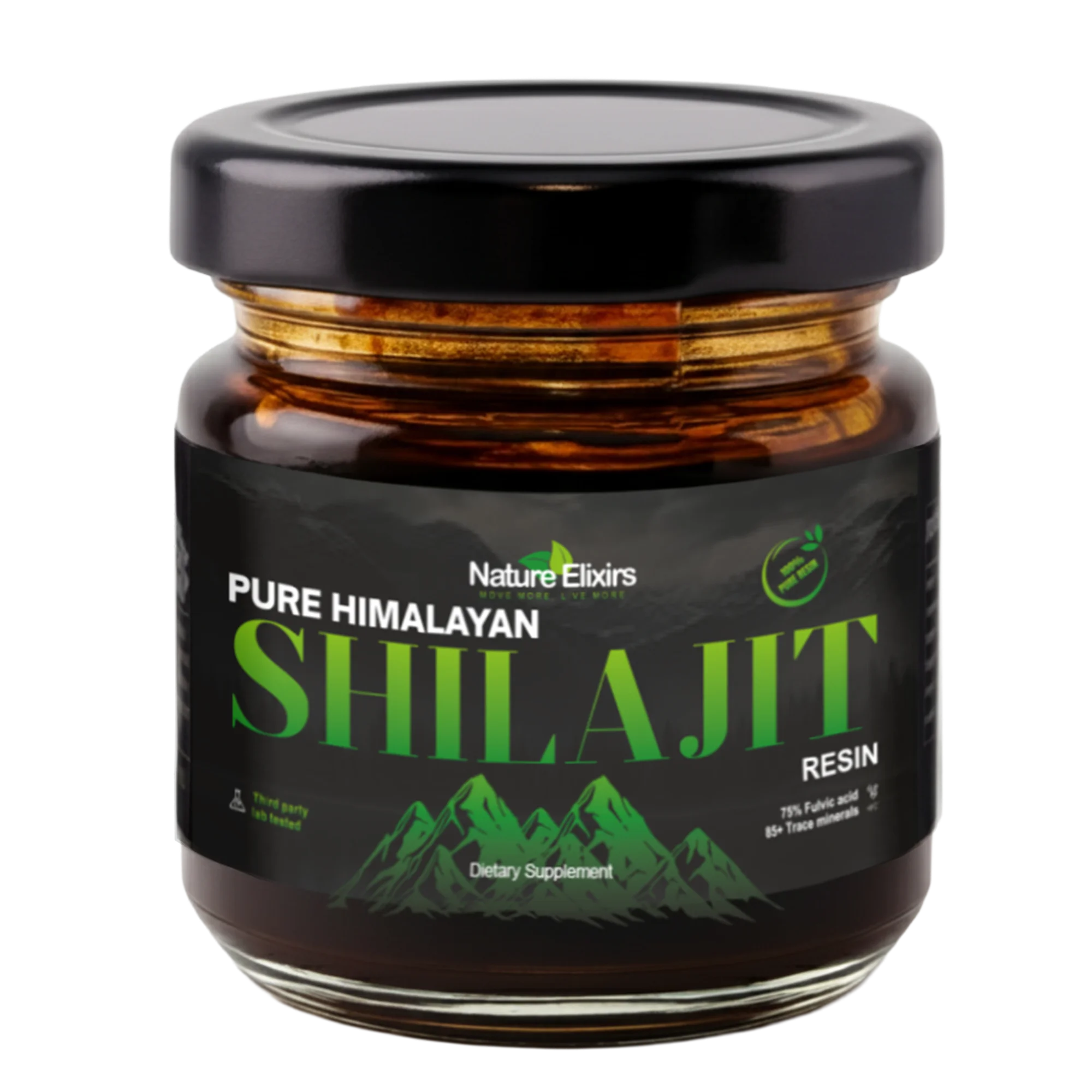
The resin these documents describe
- Pure Himalayan Shilajit Resin, 30g glass jar
- Current batch SJ2509, documented in full
- Produced at our own facility; tested by an accredited laboratory
- Dispatched from London, with a 28-day returns window
Documents you can check, on a product you can buy
Every jar carries a batch number, and every batch has a laboratory report behind it. Match the two, read the results, and decide on the evidence.
Certificates and laboratory reports describe management systems and tested samples. They are not government or medical approval, and Shilajit is sold in the UK as a food supplement, not a medicine. If you are pregnant, breastfeeding, taking medication or managing a health condition, speak to your GP or pharmacist before taking any supplement.
